


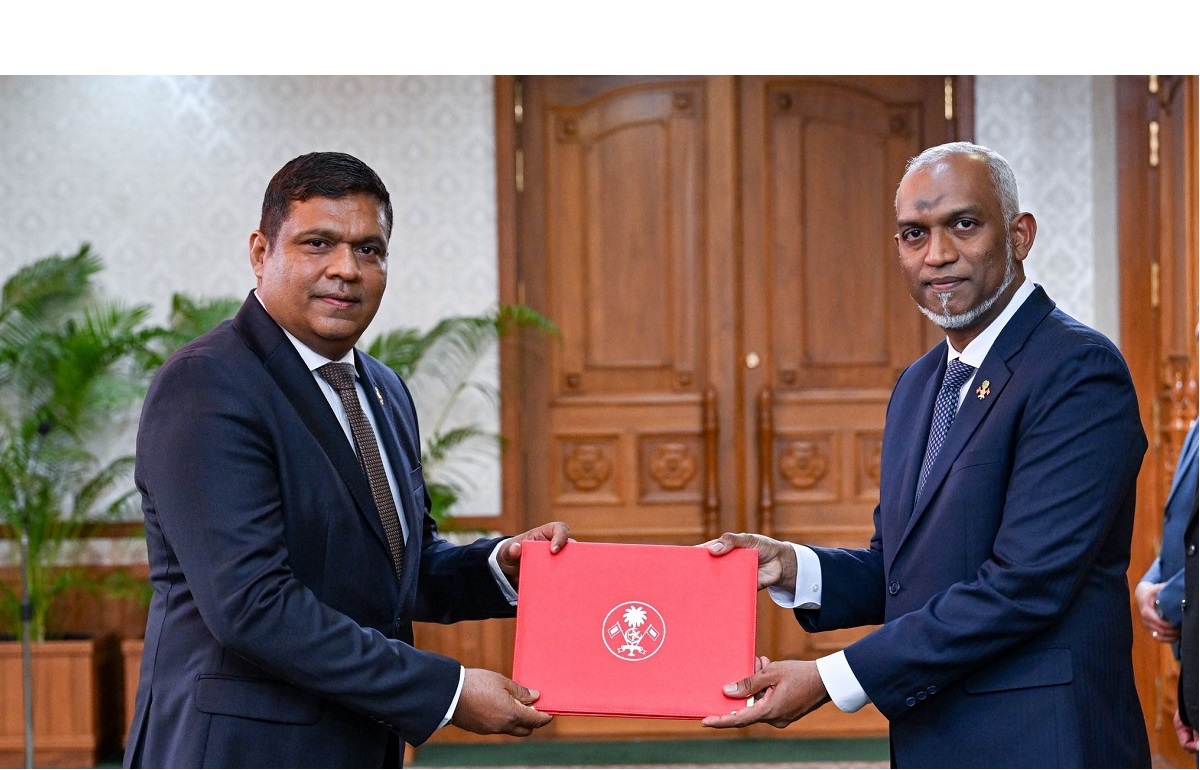
Maldivian President Mohamed Muizzu has appointed Mohamed Ameen as the Maldives’ new Minister of Tourism and Civil Aviation, in a sweeping cabinet reshuffle announced on April 14, 2026, that saw ten ministers step down in a single day as part of what the government described as an effort to improve performance and streamline governance.
Ameen, who had been serving as Minister of Transport and Civil Aviation since President Muizzu took office in November 2023, now assumes responsibility for the tourism portfolio – the cornerstone of the Maldivian economy – in addition to his existing aviation brief. His new designation combines two closely interlinked sectors under a single ministry, a structural shift that marks a significant departure from the previous administrative framework.
The appointment follows the resignation of Thoriq Ibrahim, who had been leading the Ministry of Tourism and Environment – itself a merged entity created in February 2025, when the government combined the tourism and climate change portfolios. Ameen becomes the third minister to hold the tourism brief under the Muizzu administration, following Ibrahim Faisal, who was first appointed to the role when the administration assumed office, and Thoriq Ibrahim, who led the merged ministry until his resignation this week.
Ameen is not without relevant credentials for the expanded role. Before entering cabinet, he served in senior positions at Island Aviation Services, the state-owned carrier operating as Maldivian, and has maintained a close association with the transport and civil aviation brief throughout the current administration. His background gives him a working understanding of the aviation infrastructure that underpins nearly every aspect of Maldivian tourism – from international arrivals at Velana International Airport to domestic seaplane and regional transfers serving the archipelago’s resorts.
A Structural Shift With Strategic Logic
The decision to place civil aviation under the tourism ministry rather than transport carries clear strategic intent. Tourism accounts for the single largest share of the Maldivian economy, and aviation is, quite literally, its lifeline – the mechanism through which every international visitor arrives, and through which domestic connectivity to remote atolls is maintained. Combining both portfolios under one minister eliminates a layer of inter-ministerial coordination and could allow for more unified, responsive planning as the country pursues new source markets and seeks to grow passenger volumes across its expanding resort sector.
For an economy as aviation-dependent as the Maldives, the logic of aligning connectivity policy with tourism development is difficult to argue against. Decisions on route development, airport infrastructure, airline partnerships, and seat capacity directly shape resort occupancy, arrival numbers, and ultimately, national revenue. Having a single minister accountable for both dimensions of that equation removes structural friction that has, at times, slowed decision-making.
The Caution That Must Accompany the Opportunity
Yet the restructuring is not without risk, and those risks deserve frank acknowledgement. Civil aviation is among the most technically demanding and safety-critical sectors in public administration. Regulatory oversight of flight operations, safety compliance, airworthiness standards, and operational protocols must remain insulated from the commercial pressures that tourism promotion inevitably generates. The concern is not theoretical – globally, there are cautionary examples of what happens when aviation safety oversight becomes subordinate to economic priorities.
The concentration of two major portfolios in a single ministry also raises questions of bandwidth. Tourism alone is a complex, fast-moving sector requiring sustained ministerial attention; civil aviation regulation demands an equally rigorous focus. Whether the new ministry will have the institutional depth and specialist capacity to manage both effectively without one crowding out the other is a practical question that the coming months will begin to answer.
There is also the disruption that accompanies any sudden structural reorganisation. Established processes, reporting lines, and institutional relationships take time to rebuild under new arrangements, and short-term inefficiencies during the transition period are a realistic expectation.
The Road Ahead
The success of this new arrangement will ultimately be measured not by its structural elegance but by its outcomes – in arrival numbers, in new route connectivity, in the quality of safety oversight, and in the coherence of aviation policy as it relates to the country’s broader tourism ambitions.
President Muizzu’s broader reshuffle signals a government in active recalibration, willing to make structural changes in pursuit of better performance. Whether the integration of tourism and civil aviation under Minister Ameen’s leadership proves to be a masterstroke of administrative efficiency or a structural overreach will depend almost entirely on execution – on the quality of the team assembled, the clarity of the mandates set, and the rigour with which regulatory independence is maintained even as commercial priorities are pursued.
For an island nation whose entire economic model rests on the ability of aircraft to land and tourists to arrive, getting that balance right is not simply a matter of good governance. It is an existential imperative.









Leave a Comment